


Pet Microchip Registration: Is It Free? How to Check Yours
Is Your Pet's Microchip Registered? Understanding Pet Microchips, Registries, and Registration Fees
Your pet may already have a microchip—but is it registered with your current contact information?
Many pet owners assume that having a microchip implanted automatically means their pet can be identified and returned home if lost. Unfortunately, that's not always the case.
Microchips are one of the most valuable tools for reuniting lost pets with their families. But a microchip is only as useful as the registration information connected to it.
At Clover Basin Animal Hospital, we believe microchip registration should be simple, accessible, and free of unnecessary ongoing fees. Here's what every pet owner should know about how microchips work, why there are so many different registries, and how to register your pet's microchip for free—even if the chip was implanted somewhere else.
How Do Pet Microchips Work?
A pet microchip is a tiny electronic device, approximately the size of a grain of rice, implanted beneath the skin, typically between a dog's or cat's shoulder blades.
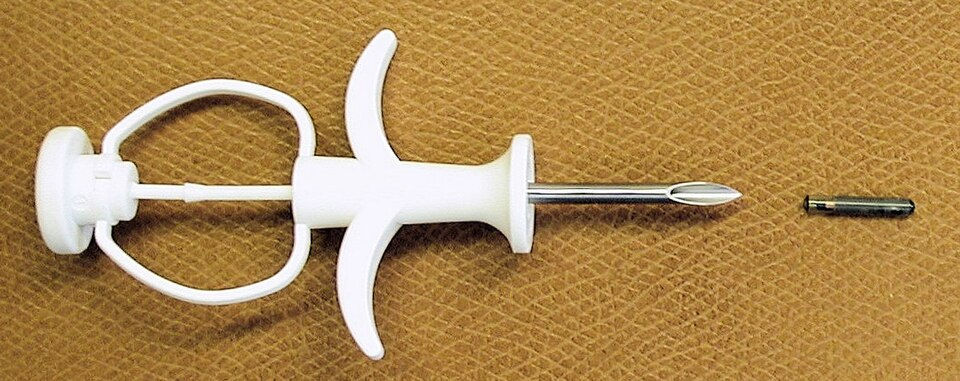
Unlike a GPS tracker, a microchip doesn't transmit your pet's location. It doesn't contain a battery, require charging, or need an ongoing service plan.
Instead, when a veterinarian, animal shelter, or animal control officer scans the chip with a compatible reader, it transmits a unique identification number.
That number can be used to locate your contact information through a microchip registry.[1]
Microchipping is highly effective. According to a study cited by the American Veterinary Medical Association (AVMA), microchipped dogs entering animal shelters were more than twice as likely to be returned to their owners, while microchipped cats were more than 20 times as likely to be reunited with their families.[2]
But there's an important catch: the microchip doesn't actually store your name, address, or phone number. That information must be maintained separately in a registration database.
Why Are There So Many Microchip Registries?
One of the most confusing aspects of pet microchipping is that there isn't one central national registration database in the United States.
Companies such as HomeAgain, 24PetWatch, AKC Reunite, PetLink, and 911PetChip offer microchip identification or registration services. Some manufacture or distribute the physical microchips, while others primarily maintain databases connecting microchip numbers to pet owners.
These are two separate services:
Microchip implantation: Places a permanent identification device in your pet.
Microchip registration: Associates the chip's identification number with your contact information.
You do not necessarily have to register your pet's microchip with the company that manufactured it. Many independent registries accept microchips from any manufacturer.
The American Animal Hospital Association (AAHA) helps connect these separate databases through its Universal Pet Microchip Lookup Tool at www.petmicrochiplookup.org.
At www.petmicrochiplookup.org, anyone can enter a microchip number and identify participating registries that may hold the pet's registration information.
AAHA doesn't maintain owner registrations itself. Its lookup tool simply helps people locate the appropriate registry, which can then assist in contacting the owner.[3]
Do You Have to Pay to Register a Pet's Microchip?
No. Paying an annual subscription or membership fee is not required to keep your pet's microchip working or to maintain a registration with a free registry.
Some microchip companies charge an initial registration fee, offer paid lifetime enrollment, or sell optional annual memberships.
These services may include additional benefits, such as enhanced lost-pet assistance, travel assistance, or other membership features.
There's nothing inherently wrong with offering optional services, but the distinction between basic identification and additional paid benefits isn't always clear to consumers.
This can lead pet owners to believe they must purchase a membership, renew a subscription, or pay to keep their microchip active.
The physical microchip itself does not expire when a subscription ends. And while individual registry policies differ, pet owners have alternatives to paying ongoing registration fees.
For example, Free Pet Chip Registry, operated by 911PetChip, offers free lifetime registration for microchips of any brand, including free contact-information updates and ownership transfers.[4]
The most important thing isn't whether you're paying a company. It's whether your pet's microchip number is associated with accurate, accessible contact information in a reliable registry.
What Are ISO-Compliant and ICAR-Certified Microchips?
Not all pet microchips use identical technology.
International standards ISO 11784 and ISO 11785 establish specifications for animal identification microchips and compatible reading systems.
Modern ISO-compliant pet microchips typically operate at 134.2 kHz and use a 15-digit identification number. These standards improve compatibility with scanners used in veterinary clinics, animal shelters, and internationally.[5]
You may also encounter the term ICAR certification.
ICAR, the International Committee for Animal Recording, provides independent testing and certification of animal identification devices for conformity with ISO standards.
ICAR certification helps verify that a particular microchip product meets established technical specifications.[6]
At Clover Basin Animal Hospital, we've selected 911PetChip ISO-compliant microchips to provide standardized identification along with access to free lifetime registration.
Remember, though: even a technically excellent microchip cannot reunite a lost pet with its family if the owner's contact information is missing or outdated.
Is Your Pet's Microchip Actually Registered?
If your pet was adopted from a shelter, purchased from a breeder, or microchipped by a previous veterinary clinic, don't automatically assume the chip is registered in your name.
Sometimes a microchip is implanted but never registered. In other cases, it may still be associated with a breeder, rescue organization, shelter, or previous owner.
Even correctly registered chips can become difficult to use when owners move, change phone numbers, or lose access to an old email address.
Here's how to check:
Find your pet's microchip number. Look for it on adoption paperwork, veterinary records, or a microchip certificate. If you don't have the number, your veterinarian can scan your pet.
Visit AAHA's Universal Microchip Lookup. Enter the microchip number to see which participating registries have records associated with it.
Contact the registry. Log into your existing account or contact the registry to verify that your name, phone number, address, and email are correct.
Correct any problems. Update outdated information or complete any necessary registration or ownership-transfer process.
One important detail: AAHA's lookup tool does not display private owner contact information. Finding a registry listing doesn't necessarily mean the chip is registered to you. You'll need to confirm that directly with the registry.[3]
If you adopted your pet and the chip is still registered to someone else, the registry may require adoption paperwork or other documentation before changing ownership.
Does Clover Basin Animal Hospital register microchips on behalf of the owner?
At Clover Basin Animal Hospital, we believe pet owners should have direct control over their pet's microchip registration.
Rather than registering the microchip on your behalf, we ask you to complete the registration yourself. This ensures that:
Your information is accurate. You enter your preferred contact information, including phone numbers, email addresses, and emergency contacts.
You control your account. You create your own registry account, with direct access to review and update your information whenever needed.
You understand how registration works. You'll know which registry holds your information and how to access it if your pet is ever lost.
When we implant a microchip, we'll provide its unique identification number along with an information card containing instructions for free registration.
We recommend using the free registry at https://www.freepetchipregistry.com/, but you have the option of registering with one of the other registries mentioned in this article. All the registries mentioned in this article cooperate with the AAHA Universal Microchip Lookup service.
Please register your pet's microchip as soon as possible after your appointment. Implantation alone does not complete the registration process, and an unregistered microchip may make it much more difficult to reunite you with your pet if they become lost.
How to Register Any Pet Microchip for Free
Whether your pet receives a new 911PetChip microchip at Clover Basin Animal Hospital or already has a microchip implanted elsewhere, you can use Free Pet Chip Registry to register that microchip without paying a registration fee or subscribing to an annual plan.
The registry accepts microchips from any manufacturer and participates in AAHA's Universal Pet Microchip Lookup network.[3][4]
Follow These Steps
Step 1: Get your pet's microchip number.
If CBAH implanted your pet's microchip, we can provide its identification number. If the microchip was implanted elsewhere, check your paperwork or ask a veterinary clinic to scan your pet.
If CBAH implants your pet's microchip, we'll provide its unique identification number and an information card with instructions for registering it at no charge. You'll complete the registration yourself so that you can establish your own account and maintain direct control of your contact information.
If your pet was microchipped elsewhere, check your pets records from that organization or ask our reception desk to scan your pet.
Step 2: Check its existing registration.
Visit www.petmicrochiplookup.org to see whether an AAHA-participating registry already has a record for your pet's chip.
If it is already registered to you, verify that your information is current. You don't need to create another registration simply because a different registry is available.
Step 3: Register for free.
Visit www.freepetchipregistry.com and create a free account.
Enter your pet's microchip number, your contact information, and the requested pet details.
There is no initial registration fee, annual subscription, or charge for future contact-information updates.
If the chip is already registered to another person, follow the registry's ownership-verification procedures rather than creating a conflicting ownership record.
Step 4: Verify your registration.
After completing registration, save your account information and confirm that your pet's details are correct.
You can also search the microchip number again using AAHA's lookup tool to confirm that Free Pet Chip Registry appears among the participating registries associated with the chip.
Step 5: Keep your contact information current.
Whenever you move, change telephone numbers, or update your email address, update your pet's registration.
Consider including a secondary emergency contact as well.
A Microchip Is Permanent. Your Contact Information Isn't.
Microchipping provides a permanent way to identify your pet, but registration is what connects that identification to you.
Our recommendation is simple: have your pet microchipped, make sure the chip is registered to the correct owner, and keep the contact information current.
You should never assume your pet's microchip is registered simply because it has been implanted.
At Clover Basin Animal Hospital, we're happy to help you locate your pet's microchip number or check whether a microchip is present. And whether your pet has one of our 911PetChip microchips or a different brand implanted elsewhere, there is a free registration option available.
A few minutes spent checking your pet's registration today could make all the difference if your pet ever goes missing.
References
[1] American Animal Hospital Association. FAQs for AAHA Universal Pet Microchip Lookup Tool. https://www.aaha.org/faqs/
[2] American Veterinary Medical Association. Microchipping: FAQs for Pet Owners. https://avma.org/microchipping-animals-faq
[3] American Animal Hospital Association. Microchip Registry Lookup Tool. https://www.aaha.org/for-veterinary-professionals/microchip-registry-lookup-tool-aaha-find-your-pets-microchip-registry/
[4] Free Pet Chip Registry. Frequently Asked Questions. https://www.freepetchipregistry.com/faqs/
[5] American Veterinary Medical Association. Microchipping: FAQs for Pet Owners. https://avma.org/microchipping-animals-faq
[6] International Committee for Animal Recording. RFID Devices Certified for Conformance With ISO 11784/11785. https://www.icar.org/rfid-devices-currently-certified-for-conformance-with-iso-11784-11785/


Comments